

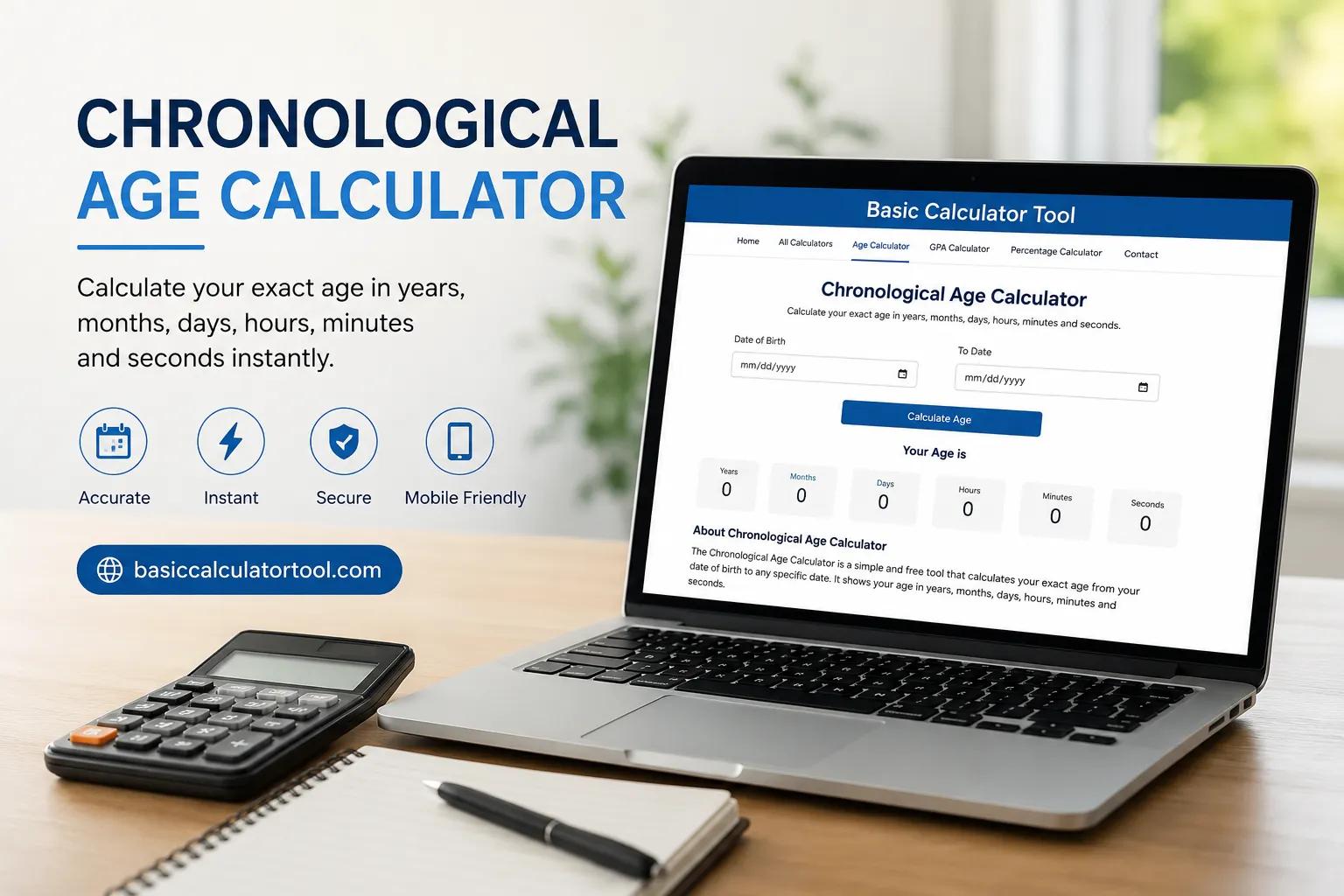

Have you ever found yourself counting on your fingers, trying to figure out your exact age down to the specific day? Measuring time seems simple at first glance, but standard calendar math often gets complicated when leap years, varying month lengths, and specific target dates enter the mix. Calculating exact age is a common task for official paperwork, academic evaluations, job applications, and health assessments. A precise calculation ensures that you meet strict eligibility criteria without any margin for error.
While most people rely on simple math in their heads, everyday mental arithmetic often overlooks the hidden nuances of time measurement. For simple everyday math, a Basic Calculator gets the job done, but computing precise dates requires accounting for every single calendar variation.
Using a digital chronological age calculator removes the guesswork entirely. It delivers an instant, highly accurate breakdown of your life journey measured in years, months, weeks, and days. In this comprehensive guide, we will explore why exact age tracking matters, how date tracking software operates, and how digital tools simplify accurate record-keeping across professional, medical, and personal fields.
Understanding Chronological Age and How It Works
Chronological age represents the total time elapsed from your exact moment of birth to a specific target date. Unlike biological age, which reflects how fast your cellular health or body system is aging, chronological time is strictly grounded in the passage of the calendar.
The Mechanics of Date Math
Calculating date intervals requires systematic subtraction across three specific metrics: days, months, and years. When doing this manually, you start from the right side with days and work your way left toward years.
Subtract the day of birth from the target day. If the target day is smaller, you borrow 30 or 31 days from the target month column.
Subtract the month of birth from the target month. If the target month is smaller, you borrow 12 months from the target year column.
Subtract the birth year from the target year to find the remaining years.
When you need quick math for standard figures, using a Basic Calculator works well, but date math involves dynamic calendar rules that simple addition or subtraction cannot easily handle.
Leap Years and Variable Month Lengths
The primary reason manual age calculation becomes tricky is the irregularity of our calendar system. A standard solar year lasts approximately 365.2425 days according to historical records documented on Wikipedia. Because of this fractional day, leap years add an extra day to February every four years.
Furthermore, months vary between 28, 29, 30, and 31 days. A specialized chronological age calculator automatically factors in these specific calendar quirks, ensuring that every leap day is counted accurately.
Key Applications Across Professional and Personal Sectors
Having precise age calculations is essential across many modern fields. Accurate tracking eliminates operational friction and guarantees compliance with formal standards.
1. Education and Child Development Assessment
Schools, pediatricians, and child psychologists regularly rely on exact age metrics. Standardized tests, developmental milestone evaluations, and speech therapy assessments require scoring based on a child's exact age in years, months, and days.
School Enrollment: Ensuring children meet state or local age cutoffs down to the exact day.
Psychometric Testing: Comparing individual performance against standardized national samples.
Immunization Tracking: Administering pediatric vaccines precisely according to scheduled age intervals.
2. Legal, HR, and Institutional Compliance
Human resource departments and legal administrators process age-sensitive records daily. Whether determining retirement eligibility, verifying legal working age, or processing insurance policies, exact dates protect organizations from regulatory errors.
Pension and Retirement Planning: Calculating precise milestone dates for benefit disbursement.
Insurance Underwriting: Establishing accurate risk profiles based on verified date intervals.
Legal Documentation: Verifying age eligibility for passports, licenses, and official contracts.
3. Sports, Athletics, and Competitive Leagues
Youth sports organizations and international athletic associations group competitors strictly by age categories. Even a single day's difference can determine whether an athlete qualifies for a specific division or tournament bracket.
Comparing Calculation Methods
People track age intervals using three common methods: manual subtraction, digital spreadsheets, and online calculation tools. Each approach offers clear trade-offs between simplicity, speed, and precision.
Manual Calculation: This classic method uses pen and paper to subtract birth dates from target dates. It works well for rough estimates, but manual borrowing between days and months frequently leads to human error.
Standard Pocket Tools: Performing quick date arithmetic on a Basic Calculator requires converting dates entirely into total days first. While it provides basic mathematical support, it lacks native calendar logic.
Digital Calculators: A dedicated chronological age calculator offers instant, precise results. By entering two dates, users receive an error-free breakdown that accounts for leap years and month lengths automatically.
Step-by-Step Guide: How to Calculate Exact Age Manually
To understand how a digital tool processes your information, it helps to walk through a manual calculation example step by step.
Step 1: Align the Dates
Write down the target date (today's date or a past/future milestone) at the top, and place the date of birth directly underneath it. Format both dates as Year, Month, and Day.
Target Date: Year 2026, Month 08, Day 30
Birth Date: Year 1995, Month 11, Day 15
Step 2: Subtract the Days
Look at the days column. Subtract 15 days from 30 days. This gives you 15 days remaining.
Step 3: Subtract the Months
Look at the months column. You need to subtract 11 months from 08 months. Because 08 is smaller than 11, you must borrow 1 year from the target year column.
Subtract 1 year from 2026, leaving 2025.
Add 12 months to 08 months, giving you 20 months.
Now subtract 11 months from 20 months, which leaves 09 months.
Step 4: Subtract the Years
Finally, subtract the birth year (1995) from the updated target year (2025). This leaves 30 years.
Final Calculated Result: 30 Years, 9 Months, and 15 Days.
While manual subtraction works, using an online chronological age calculator saves time and prevents borrowing mistakes during complex date transformations.
The Evolution of Timekeeping Tools
Time measurement has evolved significantly over human history. Ancient civilizations relied on solar dials, lunar phases, and star alignments to monitor seasons and age progression.
According to updates in science and technology coverage on Google News, modern digital algorithms now process high-precision temporal calculations instantly. Today, web applications use server-side date objects to process complex calendar math in milliseconds.
When you quickly want to tally simple numbers, tapping on a Basic Calculator remains convenient. However, when processing complex calendar algorithms, web-based applications perform multi-step date math behind a simple user interface.
Why Digital Accuracy Matters Today
Modern software eliminates human error in date tracking. Whether you are managing administrative records or checking personal milestones, digital time tracking offers distinct advantages:
Instant Multi-Unit Outputs: See your age broken down simultaneously in years, months, weeks, days, hours, and seconds.
Future Date Projections: Easily calculate what your exact age will be on a future date, such as a retirement target or upcoming anniversary.
Zero Formula Setup: Skip complex spreadsheet formulas and get immediate results through simple drop-down menus.
Frequently Asked Questions (FAQs)
What is the primary difference between chronological age and biological age?
Chronological age measures the exact amount of time that has passed since your birth, based strictly on calendar units. Biological age measures how old your body seems based on health markers, cell condition, lifestyle factors, and physical health.
How does a chronological age calculator handle leap years?
The algorithm underlying an online chronological age calculator recognizes leap years (years divisible by 4, except for century years not divisible by 400). It automatically adds the extra day (February 29) into the total tally when computing exact age spans.
Can I calculate my age on a future date?
Yes. By setting the target date to a future year, month, and day, the tool computes exactly how old you will be on that specific day. This feature is particularly useful for retirement planning, milestone anniversaries, and future official applications.
Why do manual age calculations sometimes differ from digital results?
Manual calculations often fail to account for the varying number of days in specific months (28, 30, or 31 days) or overlook leap days. Digital software calculates the precise distance between two calendar points down to the day.
Can a Basic Calculator do date math?
A Basic Calculator performs standard arithmetic like addition, subtraction, multiplication, and division. To perform date math on it, you must manually convert dates into total days first, which requires knowing the exact number of days in every intervening month.
Is chronological age used for medical diagnosis?
Yes, doctors and researchers frequently reference chronological age to determine developmental milestones, interpret pediatric growth charts, and establish appropriate clinical dosages.
Why do standardized tests require exact chronological age down to the day?
Standardized psychological and educational assessments use age-normed scoring grids. A child aged 6 years and 1 month is compared against a different norm group than a child aged 6 years and 11 months, making exact calculation essential for accurate results.
Does time zone affect chronological age calculation?
For standard day-to-day calculations, time zones do not alter your calendar birth date. However, for exact birth minute records or international flight paperwork, local time adjustments can occasionally shift a recorded birth date by one day.
Conclusion
Understanding your exact age is more than just knowing when to blow out birthday candles. Precise date calculation is essential across education, healthcare, legal administration, and athletic organizations. While manual calculations and standard numeric tools like a Basic Calculator serve general everyday math needs, they can fall short when faced with leap years and shifting month lengths.
Using a modern chronological age calculator provides guaranteed precision, speed, and peace of mind. By automating complex date subtraction, these digital tools eliminate confusion and ensure your record-keeping is completely accurate.
Whether you are filling out important administrative paperwork, preparing standardized assessment reports, or simply curious about your life journey down to the exact day, relying on specialized date tools delivers instant, reliable answers every time.